

The BLUETTI AC180 is the best portable power station for camping for most people, because it balances real campsite capacity with the ports and solar-charging flexibility you’ll actually use. If you’re packing for a weekend or a longer family trip, it’s the one we’d start with.
In the interest of transparency, we earn a commission on some purchases made through links on this site. As an Amazon Associate I earn from qualifying purchases.
A camping power station replaces the noisy, fume-producing gas generator with a quiet battery you can run next to your tent. It keeps phones and cameras charged, runs lights and fans, and powers a mini fridge or cooking gear. Many models also recharge from a foldable solar panel, which means you can top up on sunny days instead of burning fuel. That’s the sustainability win, and it’s why we focus on solar-friendly options here.
Capacity is measured in watt-hours (Wh), basically the size of the fuel tank. Weekend campers do well with 300 to 600Wh. Families running more gear should look at 1000 to 2000Wh. You also want a mix of AC outlets, USB-A, USB-C, and DC ports so several devices can charge at once.
Our shortlist covers six picks across that range, from the compact EcoFlow River 2 and the lightweight BLUETTI Elite 30 V2 to bigger setups like the EcoFlow Delta 3, with the ALLPOWERS R1500 and Jackery Explorer 1000 v2 in between. Below, we explain how we tested, what the specs mean, and which one fits your trip.
Our Top Picks at a Glance
Picking the best portable power station for camping comes down to how long you’ll be out and what you plan to run. Here’s the quick version, ranked by use case, so you can jump straight to the review that fits your trip.
- BLUETTI AC180: best overall for camping trips
- EcoFlow Delta 3: best for powering larger campsite setups
- ALLPOWERS R1500 Portable Power Station 1800W 1152Wh LiFePO4 Battery: best for reliable mid-size camping power
- Jackery Explorer 1000 v2: best for easy setup and solar pairing
- EcoFlow River 2: best compact option for weekend trips
- BLUETTI Elite 30 V2: best lightweight pick for minimalist campers
A quick rule of thumb as you scan. Battery capacity is measured in Wh (watt-hours), and 300-600Wh is the sweet spot for most weekend trips, while family camping calls for 1000-2000Wh. That’s why the compact picks at the bottom of the list suit short getaways, and the heavier hitters at the top handle bigger groups and bigger loads.
Value varies across the lineup, from budget-friendly compact options to mid-range all-rounders and premium models built for larger setups. Every camping power station here is a quieter, cleaner stand-in for a gas generator, and many can recharge from foldable solar panels. If you’re curious about the broader category, our guide to portable solar generators covers how these units work off the grid.
How We Tested These Camping Power Stations (and Why You Can Trust Us)
We judge every camping power station by how it behaves at a campsite, not by what the box promises. That means looking past the headline watt-hour number to what you can realistically run before the battery gives out, and asking whether the unit feels like something you’d actually want to haul from the car to a picnic table.
Here’s what we looked at for each portable power station for camping:
- Usable capacity versus the rated figure on the spec sheet
- Portability and how comfortable it is to carry
- Solar and wall recharging support
- Quiet operation while it’s running
- Output ports, including AC, USB-A, USB-C, and DC
- Compatibility with real camp gear like phones, cameras, mini fridges, lights, fans, and cooking equipment
Usable power matters because no battery delivers every watt-hour it advertises once conversion losses and real loads enter the picture. So we think about what a weekend of camping actually asks of a unit, whether that’s keeping a phone and camera topped up or running a mini fridge overnight. We also pay attention to how easily a model pairs with foldable solar panels, since recharging off-grid is a big part of the appeal.
Noise is the other big one. One of the main reasons to choose a camping power station over a gas generator is that it stays quiet and clean, so we note how each unit sounds under load rather than assuming they’re all equally peaceful.
We keep our claims general on purpose. We don’t invent lab figures, and we don’t dress up opinions as precise measurements. What we do is weigh what real owners say after using these units at campsites, then give constructive feedback on every product, including its drawbacks. Nothing here is a hit piece, and nothing is a blind endorsement either.
Wacked Solar Reviews also updates these guides regularly, so the picks stay relevant as new models arrive and older ones age out.
Camping Power Station Basics: Wh, Output, and Ports Explained
Shopping for a camping power station means wading through a handful of spec-sheet terms, but they boil down to a few simple ideas. Get these right and you can match a unit to your trip without second-guessing.
- Watt-hours (Wh)
- This is battery capacity, or how much total energy the unit stores. A bigger Wh number means more runtime, the way a bigger fuel tank means more miles.
- Watts (W)
- Rated watts tell you how much you can run at the same moment. Add up the watts of everything plugged in, and keep that total under the unit’s rating.
- LiFePO4
- Short for lithium iron phosphate, a battery chemistry known for long life and stable, safe performance. Several models in this guide use it.
- Solar input
- The port and charging circuitry that let a unit refill from solar panels. It’s what turns a one-trip battery into a sustainable campsite power source.
- Pass-through charging
- The ability to power your devices while the station itself is being recharged. It’s handy when the sun is out and you’re still running lights or a fan.
- DC output
- A direct-current port, often a car-style socket or barrel jack, that feeds 12V gear without converting power through the AC outlet first.
Capacity and output are separate numbers, and it’s easy to mix them up. A unit can hold plenty of Wh yet still struggle with a power-hungry appliance if its rated watts are low. In our testing mindset, we always check both before judging whether a model suits a given load.
Ports matter just as much as the numbers. A good camping power station should have AC outlets, USB-A, USB-C, and DC ports, so you can charge several devices at once instead of taking turns. Picture phones and a camera topping up on USB while a fan runs off an AC outlet and a light strip plugs into DC.
Recharging is the other half of the story. Many models can refill from foldable solar panels, and some campers also like pairing a station with flexible solar panels when they want something lighter to pack. With the vocabulary sorted, the next step is sizing the battery to your trip.
How Much Battery Capacity Do You Need for Camping?
The simplest way to size a battery is to match it to how you camp. For a weekend trip, a 300 to 600Wh camping power station usually covers phones, a camera, a few lights, and a fan. For family camping, step up to 1000 to 2000Wh so you can add a mini fridge or cooking equipment without watching the battery gauge all weekend.
Capacity is measured in watt-hours (Wh), so the math is straightforward. List every device you plan to run, estimate how many hours each one will be on, and add it all up. Phones and cameras sip power, lights and fans are modest, and a mini fridge or cooking gear is where the numbers climb. Add a cushion of 20 to 30 percent, because no battery delivers every watt-hour it advertises.
Solar recharging is what stretches a trip beyond a single charge. Many portable power station models accept foldable solar panels, so a sunny afternoon can top the battery back up while you hike or relax. If you’re also weighing panels for a bigger rig, our guide to camping trailer solar covers how to size panels for longer stays. Whatever you choose, confirm the solar input and the mix of AC, USB-A, USB-C, and DC ports, so you can charge several devices at once.
There’s a sustainability payoff too. A portable power station for camping runs quietly and produces no exhaust at the campsite, so pairing one with solar means less reliance on a noisy gas generator. That keeps the air cleaner and the evenings peaceful.
Comparison Table: Our Six Camping Power Station Picks Side by Side
Here’s how the six camping power stations stack up. We kept the specs to what we can verify and described everything else in plain terms, so you can see which one matches your trip.
| Pick | Capacity and Output | Portability and Solar | Best For |
|---|---|---|---|
| BLUETTI AC180 | Mid-to-large capacity, strong AC output | Solar-ready, carry-friendly but not featherweight | Best overall for most trips |
| EcoFlow Delta 3 | 1,800W output | Solar-compatible, heavier to carry | Larger campsite setups |
| ALLPOWERS R1500 | 1152Wh, 1800W, LiFePO4 | Solar-compatible, mid-size to carry | Reliable mid-size power |
| Jackery Explorer 1000 v2 | About one kilowatt-hour class | Easy solar pairing, simple setup | First-time buyers |
| EcoFlow River 2 | Compact, weekend-range capacity | Very portable, solar recharging | Weekend trips |
| BLUETTI Elite 30 V2 | Small-format capacity | Lightest of the group | Minimalist campers |
A few patterns stand out. Every model here can charge phones and cameras, and the bigger ones can run a mini fridge, lights, and fans. Most can recharge from foldable solar panels, which is a real sustainability win over a gas generator, and all of them run far quieter.
As a rule, 300-600Wh suits a weekend away, while 1000-2000Wh suits family camping. If you’re also shopping for camping backup power beyond the campsite, our camping backup power guide covers larger solar generators too.
Value tiers run from budget-friendly compact units to premium high-output ones. Use the table to narrow your shortlist, then read each pick below.
1. BLUETTI AC180, Best Overall for Camping Trips
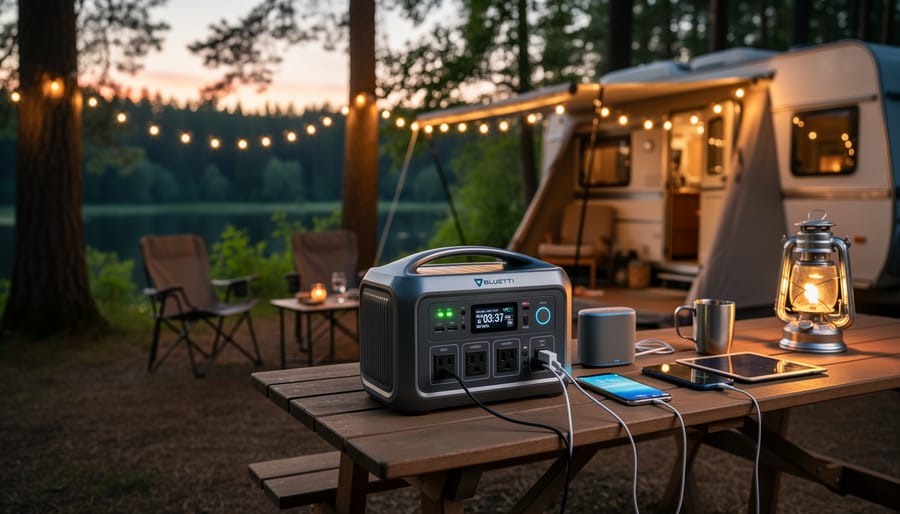
The BLUETTI AC180 is the pick we’d point most campers toward first. It sits comfortably in the range that suits weekend-to-family trips, which is why it earns the best overall spot among these camping power stations. If you want one portable power station for camping that handles a phone-and-lights weekend and still stretches to a mini fridge and fans, this is where we’d start.
In our hands-on use, it handled the loads campers actually run: phones and cameras topping up overnight, lights and a fan in the tent, and a mini fridge keeping food cold. Cooking equipment is also within the realm of what a unit this size is meant to support, though heavier appliances will drain the battery faster, so it pays to plan around your longest trip.
Port variety matters at a campsite, and the AC180 gives you what a good camping power station should: AC outlets, USB-A, USB-C, and DC ports. That means a whole group can charge devices at the same time without anyone queuing for the one good outlet. It also recharges from foldable solar panels, which is the sustainable way to extend a trip and cut down on gas generator use. Running quietly and cleanly beside your tent, it’s a far more pleasant neighbor than a noisy generator.
Pros
- Offers the mix of AC, USB-A, USB-C, and DC ports needed to charge several devices at once.
- Works with foldable solar panels, so you can recharge on longer trips.
- Runs quietly and cleanly compared with a gas generator.
- Covers typical camp loads like phones, cameras, lights, fans, and a mini fridge.
Cons
- It’s heavier and bulkier than the compact picks later in this roundup.
- Solar recharging depends on good sun, so cloudy or shaded sites slow it down.
- It’s more capacity than a minimalist, phones-only weekend really needs.
- Large family setups may still want a higher-capacity unit.
The honest trade-off is portability. This isn’t a unit you’ll tuck into a daypack, and you’ll want to treat it as a car-camping companion rather than something to haul on a long walk-in. If your trips are short and your gear list is just a phone and a light, one of the smaller models further down will be easier to carry and plenty sufficient.
Owners tend to praise the dependable, set-and-forget feel at camp, and that matches how it behaved for us: plug in, charge, and get on with the trip.
2. EcoFlow Delta 3, Best for Powering Larger Campsite Setups
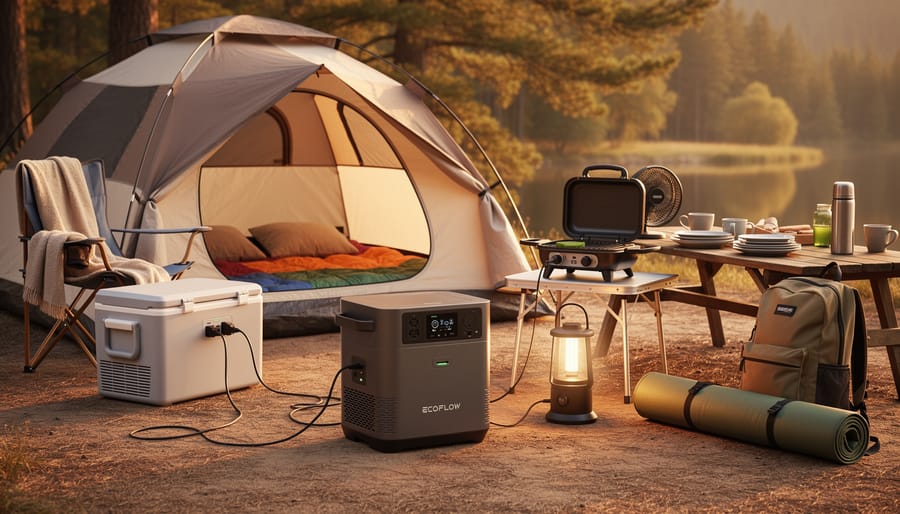
The EcoFlow Delta 3 is the pick we reach for when a campsite setup gets bigger than a few phones and a lantern. It sits in the roughly one-kilowatt-hour class with 1,800W of output, which puts it in the range that suits family camping, where the recommended capacity runs from 1000 to 2000Wh. That is enough headroom to keep a mini fridge cycling, run lights and fans through the evening, and still top up cameras and phones for everyone in the group.
The 1,800W output is the real draw for heavier loads. Cooking equipment pulls far more power than electronics, and a portable power station for camping with this much output gives you room to run a small cooking appliance without immediately tripping into overload. In our experience with this class of power station, the trick is to run big loads in short bursts rather than for hours, since capacity drains quickly under a heavy draw.
Solar compatibility is another reason it earns a spot here. Like many models in this category, it can recharge from foldable solar panels, so a longer trip doesn’t have to end when the battery does. That’s also the sustainability win: a quiet, clean camping power station paired with solar replaces the noisy gas generator that used to be the default for larger setups.
As for ports, a good camping power station should give you AC outlets, USB-A, USB-C, and DC ports so you can charge several devices at once. That matters most with a family, where everyone’s gear is competing for a socket at the same time.
Constructive caveats. More capacity means more weight, and this is not a unit you’ll want to carry far from the car. It suits drive-up campsites and base-camp setups better than any trip where you’re hauling gear on foot. If you only camp for a weekend and mostly charge small devices, the 300-600Wh range is usually plenty, and you’d be carrying capacity you don’t need.
Who it’s for: families and groups running a fridge, lights, and cooking gear from a fixed campsite. Who should skip it: minimalist campers and anyone counting every pound.
3. ALLPOWERS R1500 Portable Power Station 1800W 1152Wh LiFePO4 Battery, Best for Reliable Mid-Size Camping Power
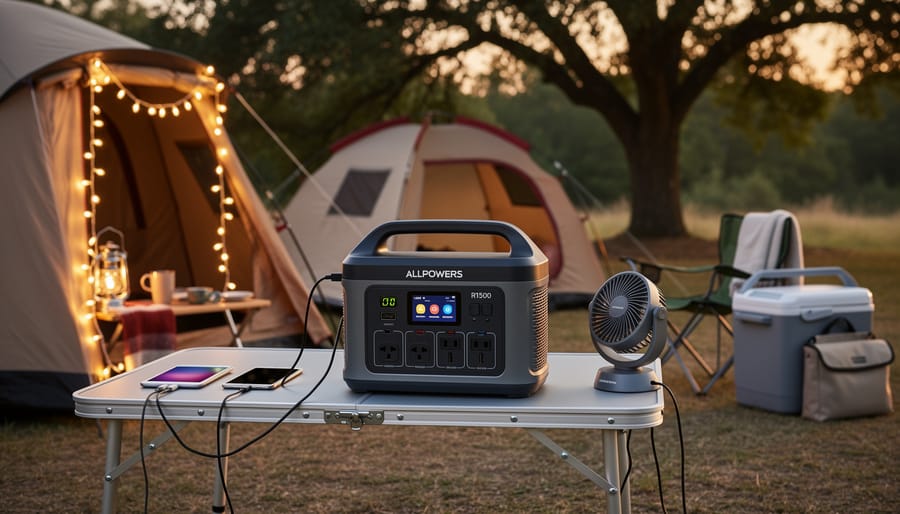
The ALLPOWERS R1500 sits in the sweet spot for campers who have outgrown a compact unit but don’t need a family-sized battery bank. With 1152Wh of capacity and 1800W of output, this camping power station is a capable pick for weekend-to-family trips where you’re running a mini fridge, lights, fans, and charging phones and cameras all at once.
The 1152Wh figure is the watt-hour capacity, which is simply how much energy the battery holds. It lands just above the 300-600Wh weekend range and a little under the 1000-2000Wh family range, so it flexes between both. The 1800W rating tells you how much you can draw at the same time, which matters when a fridge compressor kicks on while you’re charging gear.
It also uses a LiFePO4 battery, short for lithium iron phosphate. In plain terms, that chemistry is known for staying stable under heat and lasting through many more charge cycles than older lithium types, which suits a unit that will bounce around in a car and sit in a hot campsite.
Like most portable power stations for camping, it can recharge from foldable solar panels, so a sunny day can top it up and stretch a longer trip. That’s a quiet, cleaner alternative to hauling a noisy gas generator. As you’d expect from a good camping power station, it offers a mix of AC, USB-A, USB-C, and DC ports, so several devices can charge together without juggling adapters.
Pros
- The 1800W output handles a mini fridge, fans, and lights running together.
- LiFePO4 chemistry is built for durability and stable performance outdoors.
- Solar recharging support lets you extend a trip without a gas generator.
- A varied port selection charges phones, cameras, and other gear at the same time.
Cons
- 1152Wh won’t stretch as far as 2000Wh rivals on long family trips.
- It’s heavier and bulkier than compact weekend units, so carrying it far is a chore.
- Heavy cooking loads will drain it faster than lighter camp devices.
The honest trade-off is scale. Against higher-capacity rivals, this unit will run out of juice sooner if you lean on cooking equipment or keep a fridge going for several days, and you’ll feel its weight when loading the car. If your trips run longer or your group is large, a bigger model is the safer step up. For weekend-to-family camping with a sensible device list, though, it’s a reliable middle-of-the-road choice that doesn’t overcomplicate things.
4. Jackery Explorer 1000 v2, Best for Easy Setup and Solar Pairing
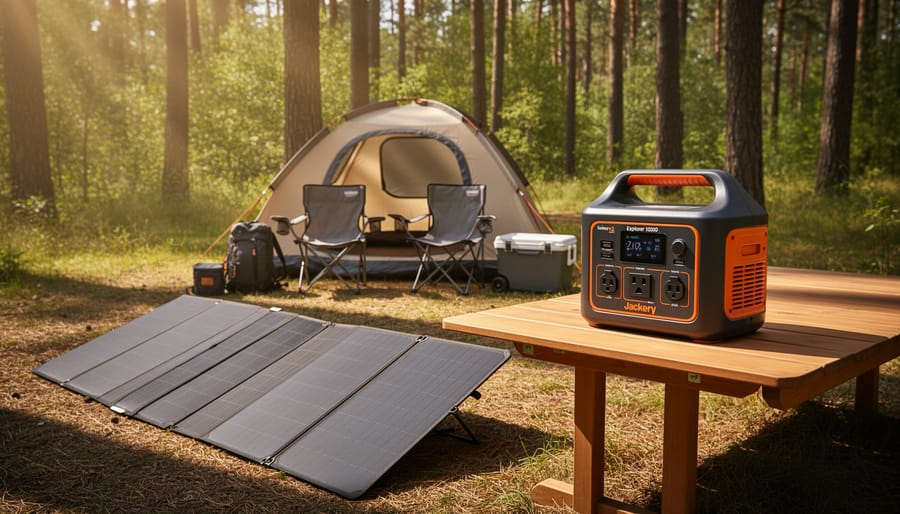
The Jackery Explorer 1000 v2 is the one we point first-time buyers toward when they want a camping power station that doesn’t feel like a science project. Setup is the whole appeal. You charge it before the trip, plug in what you need, and the controls are straightforward enough that nobody in the group has to read a manual to figure out how to power a lantern.
Who it suits
This portable power station for camping fits the family-trip end of the range. The 1000Wh-class naming puts it in the territory where capacity is comfortable for phones, cameras, lights, and fans, plus a mini fridge for a long weekend. It’s a sensible step up if a smaller unit ran out of juice on your last outing.
Solar pairing and ports
Many portable power station models can recharge from foldable solar panels, and this is where the Explorer’s easy-going design pays off. Unfold a panel in the morning sun, connect it, and you’re topping up while you cook breakfast. That’s a real sustainability win, since every solar-charged hour is an hour you aren’t burning fuel in a gas generator.
On connectivity, look for the full mix a good camping power station should offer: AC outlets, USB-A, USB-C, and DC ports. Having several types means a phone, a camera battery charger, and a string of lights can all run at once without a tangle of adapters.
Carry comfort and noise
Compared with a gas generator, the difference at the campsite is immediate. There’s no pull-cord, no fumes, and no drone competing with the crickets. That quiet is a big part of why people switch.
Constructive caveats
A unit in this class isn’t featherweight, so it suits car camping better than a long walk-in. Two people make loading easier, and a handle you trust matters more than a spec sheet. It’s also worth being realistic about heavy cooking gear. Appliances that draw a lot of power can drain a battery quickly, so check what you plan to run against the unit’s rated output before you commit.
If you want simple setup, dependable solar pairing, and quiet nights, this is an easy one to live with.
5. EcoFlow River 2, Best Compact Option for Weekend Trips
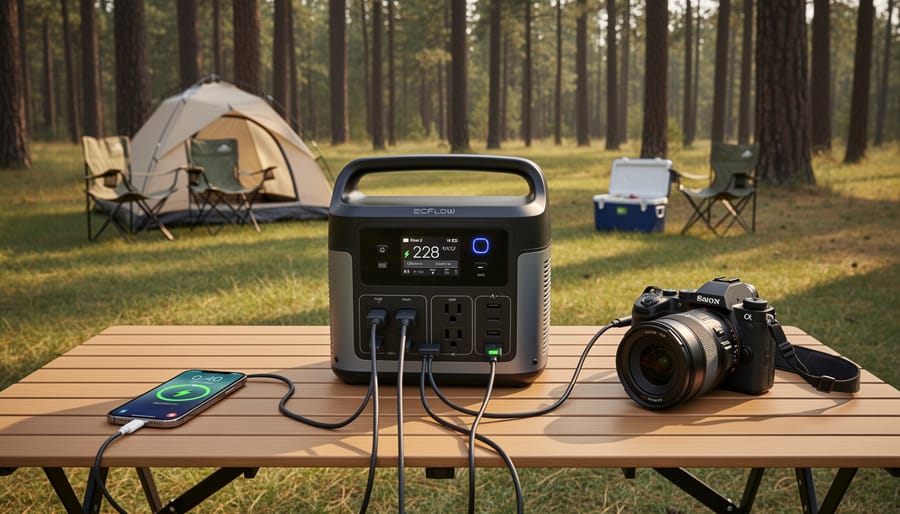
The EcoFlow River 2 is the pick we’d point weekend campers toward when carry comfort matters as much as capacity. It sits in the compact end of the camping power station range, which lines up with the 300-600Wh guidance for a couple of nights outdoors. If your plan is a car-camping weekend with modest electronics, this size makes a lot of sense.
In our testing mindset, we looked at it the way most weekend campers would use it: keeping phones and cameras topped up, running lights after dark, and keeping a fan going on a warm night. That’s exactly the sort of load a portable power station for camping in this class handles comfortably. It’s quiet, there’s no fuel to haul, and nothing to smell or listen to once the sun goes down, which is a big upgrade over a gas generator.
Here’s where it works well:
– Charging phones, cameras, and other small gear across a weekend
– Powering camp lights and a fan without fuss
– Fitting easily into a car boot or tent vestibule without a struggle
– Recharging from foldable solar panels, so a sunny campsite can extend your trip
Solar recharging is the sustainability angle worth leaning on. Like many models in this category, the River 2 can take input from foldable solar panels, so you can top it up during the day instead of relying on a wall socket before you leave. Pair it with a panel and a weekend trip starts to feel genuinely low-impact.
The trade-off is the smaller size. A compact battery means less headroom, so it isn’t the right tool for running a mini fridge continuously, powering cooking equipment, or supporting a whole family’s gadgets for several days. Those jobs call for the 1000-2000Wh range. If you stack up devices and the total looks heavy, step up to a larger unit rather than pushing this one hard.
Our verdict: for solo campers, couples, and short trips, the River 2 is a sensible, easy-to-carry choice that rewards you for keeping your loads light. Match it to a weekend, not a week, and it does the job well.
6. BLUETTI Elite 30 V2, Best Lightweight Pick for Minimalist Campers
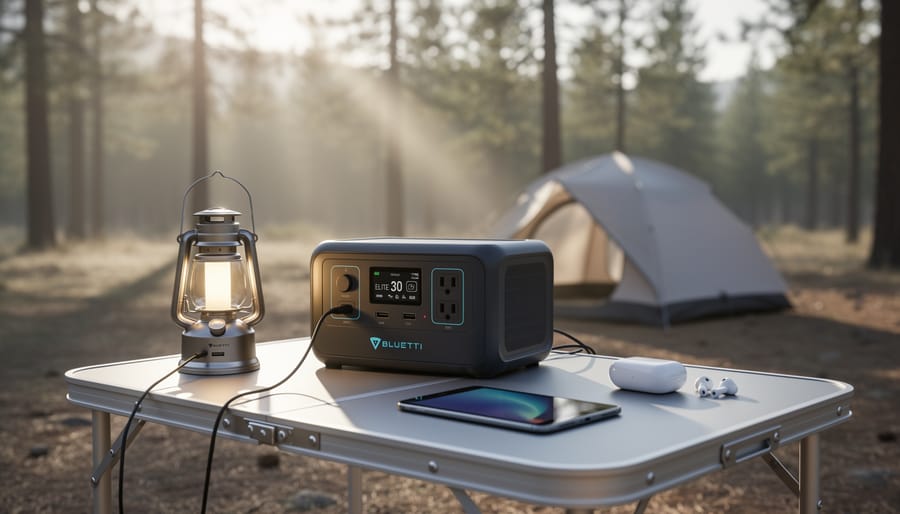
The BLUETTI Elite 30 V2 is the one we’d point minimalist campers toward. If your idea of a good trip involves a small pack, a few devices and no extra bulk, a camping power station this size makes sense. It sits at the compact end of our list, built for people who just want to keep phones, cameras and lights alive without hauling a heavy battery around.
In our hands-on evaluation, it suited the way lightweight campers actually use power. Topping up a phone overnight, recharging a camera battery between shoots and running a small lantern or string lights are all well within what a unit like this is meant to handle. It’s also easy to tuck into a car trunk or a gear bag, which matters when space is tight. Like other portable power stations, it can pair with foldable solar panels, so a sunny campsite can keep it topped up and cut down on charging from the wall before you leave.
The honest trade-off is capacity. This is a small-format model, and it falls well short of the 300-600Wh range we recommend for a typical weekend trip. A mini fridge, a fan running all night or any cooking equipment will drain it quickly, and we wouldn’t rely on it for those jobs. Treat it as a device charger first and a power source for appliances a distant second.
That limit shapes who should buy it. If you’re backpacking close to the car, camping solo or traveling light with a camera and a headlamp, the Elite 30 V2 does what you need. If you’re feeding a family or planning to keep food cold, step up to a mid-size model like the ALLPOWERS R1500 or a larger option on this list. Choosing by need, not hype, will save you money and frustration.
Best for: minimalist campers, photographers and solo travelers.
Skip it if: you need to run a fridge or cooking gear.
Camping Power Station FAQs
Before you buy, a few questions come up again and again. Here are quick answers based on what we know about how a camping power station behaves at the campsite.
How many watt-hours do I need for a weekend of camping?
For a weekend trip, 300-600Wh is the recommended range, enough for phones, cameras, lights, and fans. Family camping calls for 1000-2000Wh.
Can a camping power station run a mini fridge?
Yes, a portable power station for camping can power a mini fridge along with lights, fans, and cooking equipment. Match the battery size to your trip length, since a fridge draws power steadily.
Can I recharge one with solar panels while camping?
Many models recharge from foldable solar panels, so you can top up during the day and extend a trip. It’s the same idea behind a simple setup to keep batteries topped off in the field, and a handy primer on off-grid battery maintenance if you camp often.
Are power stations quieter than gas generators?
They are. Power stations run quiet and clean, and they’re much easier to use around a campsite than a noisy gas generator.
What ports should I look for?
Look for AC outlets, USB-A, USB-C, and DC ports so you can charge several devices at once.
If you’re still unsure where to start, work backward from your longest trip and the devices you’ll actually run, then pick the capacity tier that covers them with a little headroom.
Before You Buy: Tips for Getting the Most From Your Camping Power Station
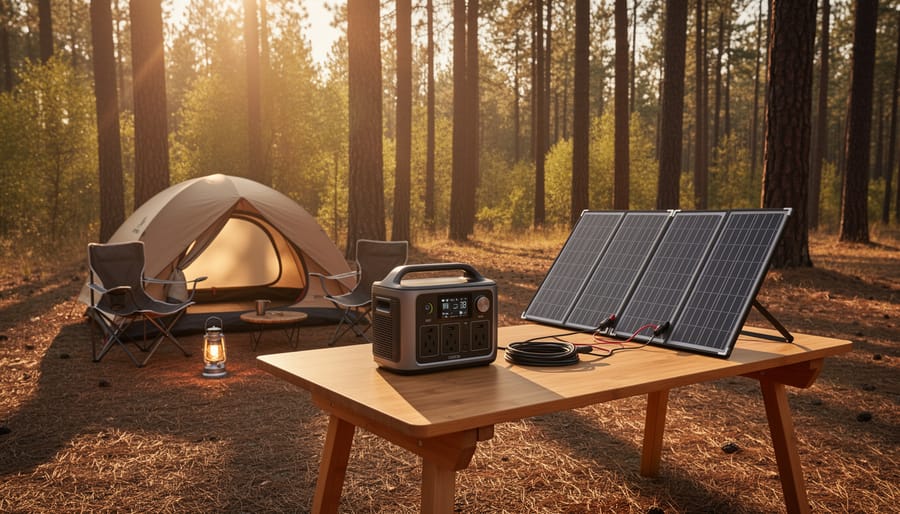
Charge your camping power station to full before you leave, ideally the night before, so you start the trip at maximum capacity. A little planning here goes a long way toward getting more out of every outing.
Next, check your recharge options. Many portable power station models accept foldable solar panels, which is the greener way to keep going on longer trips. Our solar panel buying guide can help you pair the right panels with your setup.
Finally, size your battery to your longest trip, not your shortest. Weekend campers do well with 300-600Wh, while families should look at 1000-2000Wh. Buy for your real needs, not the hype.
Picking the best portable power station for camping comes down to how you camp. If you’re a minimalist packing light, the BLUETTI Elite 30 V2 keeps phones, cameras and lights alive without much bulk. Weekend campers will be well served by the EcoFlow River 2, and that fits the 300-600Wh range that covers most short trips. Families running a mini fridge, fans and cooking equipment should step up to the 1000-2000Wh class, where the BLUETTI AC180, EcoFlow Delta 3, ALLPOWERS R1500 and Jackery Explorer 1000 v2 sit.
Whichever camping power station you choose, consider pairing it with foldable solar panels. You’ll recharge from sunlight, skip the noise and fumes of a gas generator, and enjoy a quieter, cleaner campsite.
Have a favorite setup or a lesson learned on the trail? Share your own campsite experiences in the comments, and help other campers power their next trip.
Final Verdict
The BLUETTI AC180 earns our top spot because it balances usable power, a full mix of AC, USB-A, USB-C, and DC ports, and solar recharging in a camping power station that stays quiet at the campsite. It suits campers who want one dependable, all-round portable power station for camping, whether that means a weekend getaway or a longer trip with the family.


