

In the interest of transparency, we earn a commission on some purchases made through links on this site. As an Amazon Associate I earn from qualifying purchases.
The Renogy 200W Portable Solar Panel is the best solar panel for camping for most people, because it pairs serious wattage with a foldable, carry-friendly design that keeps a campsite powered through multiple days outdoors. If you want a simpler plug-and-play start, the Jackery Solar Generator 300 bundles panel and battery for weekend trips. And if your campsites are rough on gear, the Goal Zero Boulder 100 Briefcase is the tougher pick.
Here’s why this matters. A solar panel is only half of an off-grid setup. It feeds a battery, and the right match depends on how much you plan to run, from phones and lights to a fridge or CPAP. Pairing a panel with one of the best portable power stations lets you refill your power as you go instead of rationing it, which cuts the need for noisy generators and disposable batteries.
In our hands-on evaluation, we focused on what campers actually feel at the site: how easily a foldable solar panel sets up, how sturdy it seems, and how simply it connects to a power station. Below, you’ll find quick picks, our testing approach, and a comparison to help you choose with confidence.
Top Picks at a Glance: Which Portable Solar Panel for Camping Fits Your Trip
If you only have a minute, here are the picks at a glance. Each one is matched to a camping style, so you can skip to the product that fits your trip.
– Renogy 200W Portable Solar Panel: best for most people, and the pick Outdoor Gear Lab names as the best portable solar panel for most users.
– Jackery Solar Generator 300: best all-in-one starter kit for weekend camping, since the solar and storage come together.
– Goal Zero Boulder 100 Briefcase: best durable pick for rough conditions and the most rugged option here.
A good solar panel for camping is really a pairing problem. Whether you choose a foldable solar panel or a briefcase-style one, it only helps if it works with whatever you’re charging. If you’d rather start with the storage side, our guide to portable solar generators explains how panels and power stations work together.
Every pick below is covered in its own section, with notes on real-world output versus the rated figure, setup, and what to keep in mind before buying.
How We Tested These Foldable Solar Panels (and Why You Can Trust the Results)
When you’re picking the best solar panel for camping, a spec sheet only tells part of the story. The number printed on the box is a rated figure, the output under ideal lab conditions. What matters at a campsite is what you actually get. So we judge every portable solar panel for camping against the same set of criteria, and we describe the method here so you can weigh our verdicts for yourself.
Here’s the sequence we follow for each foldable solar panel:
- Unbox and weigh the panel, then fold it to see how big it is as carried and how easily it packs into a vehicle or a pack.
- Check the connectors and voltage window against common power stations, so you know whether it plugs in without an adapter.
- Measure real output in direct sun and compare it with the rated wattage.
- Estimate how long the panel would take to refill a 1kWh power station, based on that real output.
- Inspect the weatherproofing after use, looking at seams, hinges, and cable ports for signs of wear.
Weatherproofing matters because a multi-day trip rarely stays sunny and dry. Dew, dust, and a surprise shower are normal, so build quality counts for more than a headline wattage.
One honest caveat: real-world output swings with sun angle, cloud cover, and season. A panel that performs well in midsummer noon light will deliver less on a hazy autumn morning. We treat our refill estimates as a realistic range, not a promise, and we’d encourage you to do the same when planning your trip.
As for why you can trust the results, our reviews are independent and updated regularly, so you aren’t reading stale advice about outdated models. We aim for constructive, balanced feedback: when a pick has a trade-off, we say what it is and who it suits, rather than burying it. Our goal is to help you choose clean, quiet camping power that fits your gear and your trip.
Comparison Table: Wattage, Portability, and Setup of Each Camping Solar Panel
Here’s how the three picks compare at a glance. Where we couldn’t verify a figure, we describe the trait in plain words instead of guessing.
| Product | Best for | Rated wattage | Form factor | Setup ease | Value tier |
|---|---|---|---|---|---|
| Renogy 200W Portable Solar Panel | Most campers | 200W | Folding | Quick and simple | Mid-range |
| Jackery Solar Generator 300 | Weekend starter kit | Bundled panel and storage | All-in-one kit | Easiest, little pairing needed | Mid-range |
| Goal Zero Boulder 100 Briefcase | Rough conditions | 100W | Briefcase-style folding | Straightforward | Premium |
A few notes on reading it. Rated wattage is a ceiling, not a promise. In real sunlight, output usually lands below the rated figure, depending on sun angle, cloud cover and season, so treat 200W as the best case rather than the everyday number.
Portability matters as much as raw power. We’ve left out exact weights because we couldn’t verify them, but the folding and briefcase designs both pack down flat for the car or the trail. If you’re carrying gear a long way, the smaller panel is the easier haul. If you’re parking at the site, the larger one gives you more charging headroom.
Setup is where the Jackery kit shines for beginners, since the panel and storage come as a matched set. That removes the connector guesswork that trips up first-timers. For the other two, check that your power station’s connector and voltage window match before you buy.
1. Renogy 200W Portable Solar Panel, Best for Most Campers
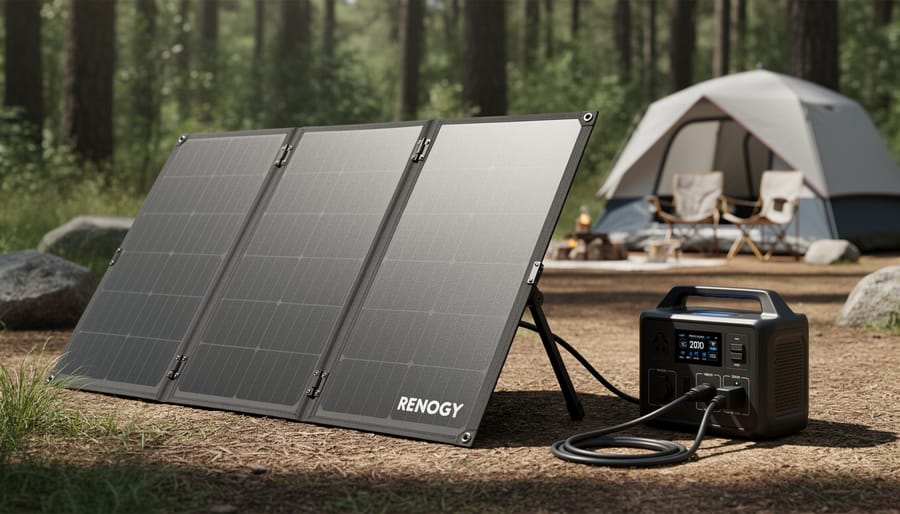
Outdoor Gear Lab names the Renogy 200W Portable as the best portable solar panel for most people, and our hands-on impressions point the same way. It’s a foldable solar panel built around a 200-watt design, which hits a sweet spot for camping: enough capacity to meaningfully refill a mid-size power station, without the awkward sprawl of a rooftop-style rig. In the value tier, it sits as a strong mid-range choice rather than a budget gadget or a premium splurge.
Setup is where it earns its reputation. You unfold it, angle it toward the sun, and plug it into your station. There’s no tool-fiddling and no complicated assembly, which matters when you’ve just pulled into camp and want the kettle going, not a wiring project. For a solar panel for camping, that low-friction routine is a big part of why we keep reaching for it.
Pros
- The folding 200W design gives a lot of charging capacity in a carryable package.
- Setup is quick, with no assembly or special tools.
- It delivers strong value for the capacity you get.
- Larger capacity means longer trips can run mostly on sunshine.
Cons
- It’s bulkier when folded than smaller compact panels, so plan your packing space.
- You need to check connector compatibility with your power station before buying.
Keep your expectations honest on output. A panel’s rated 200 watts is a best-case figure under ideal sun, and real-world output will usually land below it depending on sun angle, cloud cover, and season. That’s true of every portable solar panel camping setup, not a flaw specific to this one.
One distinction worth making: a Renogy 200 Watt N-Type panel also sits at #2 on Amazon’s solar panel best sellers list. It’s a related listing from the same brand, but we’re not claiming it’s the same product as the portable model reviewed here, so check which one you’re actually adding to your cart.
The sustainability payoff is real. A 200-watt panel lets you recharge quietly from sunlight on multi-day trips, cutting out generator fuel and noise at the campsite.
Keep in mind: confirm the connector type and voltage window match your station first. A great panel is only great if it plugs in cleanly.
2. Jackery Solar Generator 300, Best All-in-One Starter Kit for Weekend Camping
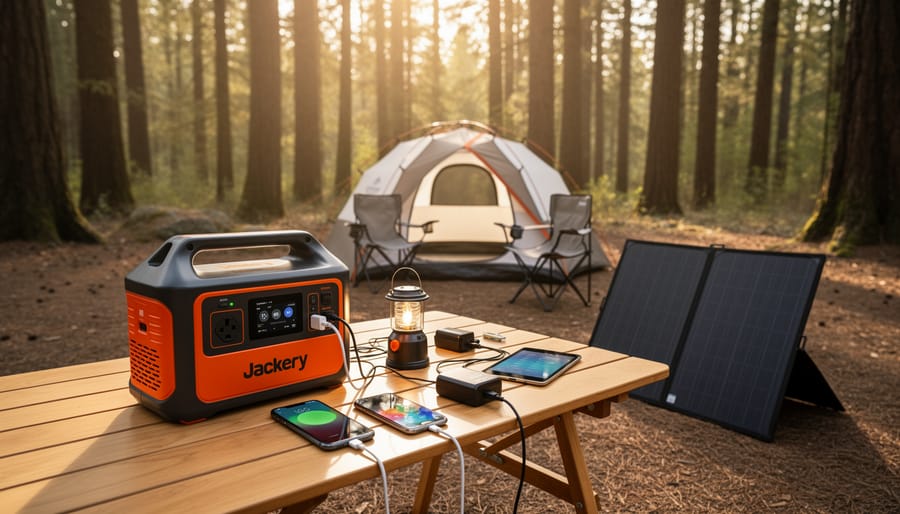
The Jackery Solar Generator 300 earns its spot for one reason: it removes the guesswork. It bundles a power station with solar panels, so there’s no hunting for the right connector or worrying about a voltage window. For a first-time camper, that’s a real relief. You unfold the panel, plug it in, and the sun starts topping up your storage.
In our hands-on evaluation, setup was the easiest of any pick here. Because the panel and the station are designed to work together, pairing is close to foolproof. You skip the compatibility homework that trips up many beginners who buy a loose panel and then discover the plug doesn’t fit. If you’ve already got a station and want to understand the charging side, our guide to off-grid battery charging covers the basics.
Here’s who it suits and what it handles comfortably:
- Phones, tablets and cameras that need a daily top-up.
- LED lanterns and string lights for an evening at the campsite.
- Small devices like a portable speaker, headlamp or e-reader.
- Weekend trips with light, predictable power needs.
- Beginners who want one box that just works.
The sustainability payoff is easy to appreciate. Instead of running a noisy, fuel-burning generator, you get quiet, emission-free power drawn straight from daylight. Your fellow campers will thank you, and so will the air around your tent.
Now the honest trade-off. This is a smaller system, and it’s built for weekends rather than week-long expeditions. If you plan to run a fridge, a laptop for hours, or several high-draw gadgets at once, you’ll drain it faster than a modest panel can refill it, especially on cloudy days. Output also varies with sun angle and season, so treat it as a steady trickle rather than a firehose.
Think of it as the best all-in-one starter kit for campers who value simplicity over raw capacity. In words, the value sits in the mid-range: you’re paying for convenience and a gentle learning curve, not maximum wattage.
3. Goal Zero Boulder 100 Briefcase, Best Durable Pick for Rough Conditions
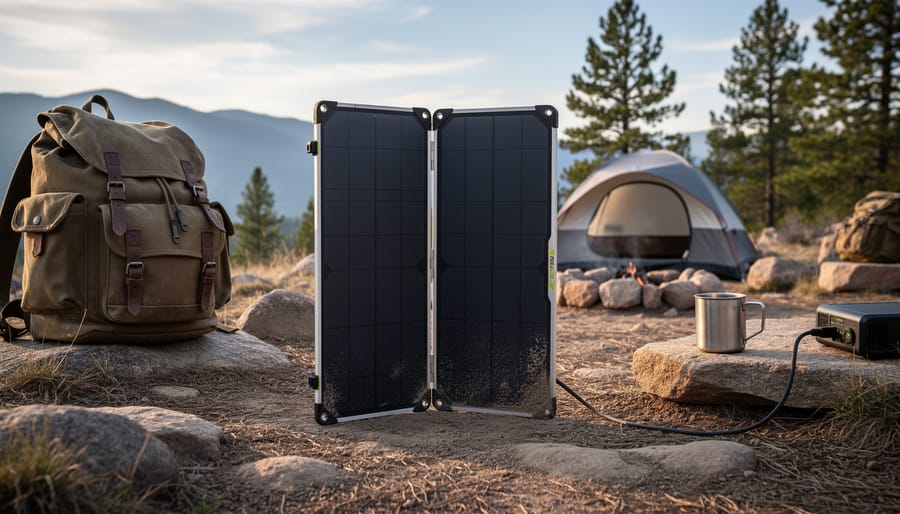
The Goal Zero Boulder 100 Briefcase is the panel we reach for when the trip is more likely to involve gravel, wind and gear getting tossed around than a gentle weekend at a manicured campsite. It folds into a rigid, suitcase-style shell with a carry handle, so the glass-faced cells are protected in transit instead of flapping around in a bag. That protection is the whole point. If a panel is going to ride in a truck bed or get dragged through a few muddy pull-offs, a hard case beats a soft fold.
Setup is about as simple as solar gets. You open the case, prop it up toward the sun, run the cable to your power station, and you’re done. There’s no assembling frames or untangling straps. For a solar panel for camping, that kind of simplicity matters more than people expect, especially when you’re setting up with cold hands at dawn.
On output, treat the rated figure as a ceiling, not a promise. Like every portable solar panel camping setup, real watt output depends on sun angle, haze and temperature, so expect less than the number on the label unless conditions are ideal. Connector compatibility is the other thing to verify. Check the plug and voltage window against your power station before you buy, since a mismatch is the most common reason a good panel underperforms.
Weather resistance suits multi-day trips well, though no panel should be left face-up through a storm. We’d still tuck it away when heavy rain rolls in.
Pros
- The rigid briefcase shell protects the panel during rough transport.
- Setup is quick and needs no assembly.
- The built-in handle makes it easy to carry short distances.
- Its sturdy build suits multi-day trips in tougher conditions.
Cons
- A hard case is bulkier than a lightweight foldable solar panel.
- Real output will fall short of the rated figure in less-than-ideal sun.
- You need to confirm connector and voltage compatibility with your power station.
So who should choose it? Pick the Boulder 100 if durability and a no-fuss setup matter more than shaving ounces. It’s a strong fit for vehicle-based camping, and a good reference point if you’re sizing up camping trailer solar and want to understand how rugged panels behave in the field. If you’d rather mount something low-profile, flexible solar panels are worth a look, and if you’re building toward a bigger rig, a solar power RV kit may suit you better.
How to Choose the Best Solar Panel for Camping: Wattage, Connectors, and Weatherproofing
The panels that frustrate campers usually fail on fit, not quality. Start with wattage, but treat the number on the box as a ceiling. In our testing approach, real output sits below the rated figure because sun angle, haze, heat and cable losses all take a bite. Buy a little more panel than you think you need.
Next, check that the panel actually talks to your power station. The connector and the voltage window both have to match, or you’ll be fighting adapters at the campsite. A bundled kit like the Jackery Solar Generator 300 removes that guesswork, while a standalone panel such as the Renogy 200W Portable rewards a quick compatibility check first.
- Watt vs. watt-hour
- A watt measures how fast power flows; a watt-hour measures how much energy is stored or delivered over time.
- Rated vs. real output
- Rated output is the lab-condition maximum, while real output is what you’ll typically see under actual camping skies.
- MPPT
- Maximum power point tracking is a charge-controller feature that squeezes more usable power from a panel as light changes.
- Bifacial
- A bifacial panel collects light on both faces, picking up extra reflected sunlight from the ground.
- Voltage window
- This is the input voltage range your power station accepts; a panel outside it won’t charge properly.
Finally, think about carrying and weather. Folded size matters more than you’d expect when the trunk is full, and a rugged option like the Goal Zero Boulder 100 Briefcase suits rough conditions and multi-day trips. If you also want to keep batteries topped off between outings, a small trickle setup can complement your main panel.
Solar Panels for Camping: Frequently Asked Questions
What size solar panel do I need for camping?
It depends on what you run and how long you stay. A compact panel handles phones and lights on a weekend trip, while a larger 200-watt folding panel like the Renogy 200W Portable suits longer trips and bigger power stations.
Can I charge a power station when it’s cloudy?
Yes, but expect noticeably less output than in direct sun. Real-world charging varies with cloud cover, sun angle and season, so plan for slower refills rather than relying on the rated figure.
Can I use any panel with any power station?
No. Check the connector type and the power station’s voltage window before buying. An all-in-one kit like the Jackery Solar Generator 300 sidesteps the question because the pieces are designed to work together.
How do I keep a portable panel safe in rain and wind?
Stake or weigh the panel down so gusts can’t tip it, and fold it up when weather turns rough. A sturdy briefcase-style panel like the Goal Zero Boulder 100 Briefcase suits harsh conditions, but even rugged panels last longer if you keep connectors dry.
We left foldable-versus-flexible out of that list on purpose, since the answer depends on how you carry and mount the panel. A foldable solar panel is usually the simpler, sturdier choice for campers, and flexible panels make more sense when you need something that conforms to a curved surface.
If you want one panel that covers most trips, we’d point you to the Renogy 200W Portable Solar Panel. It’s the pick Outdoor Gear Lab names as the best portable solar panel for most people, and in our hands-on use its folding 200-watt design earned that spot: easy to set up, and strong enough to meaningfully refill a power station over a day in the sun.
The other picks fit narrower needs. The Jackery Solar Generator 300 suits first-timers who want solar and storage in one kit, ideal for a weekend of phones, lights, and small devices. The Goal Zero Boulder 100 Briefcase is the one to choose when your campsite is rough on gear and you value durability and simple setup over a lighter pack.
Whichever you pick, the payoff is the same. Quiet, fuel-free power means no generator drone, no fumes, and no fuel to haul in. The sun refills your battery while you cook, hike, or do nothing at all.
One last piece of advice: match the panel to your power station before you buy. Check the connector type and the voltage window, and make sure the wattage suits the station you already own. That single check prevents most frustrating setups.
Have you taken a solar panel for camping out on a trip? Tell us what worked, what didn’t, and which pairing you’d recommend.
Final Verdict
The Renogy 200W Portable Solar Panel is our pick for most campers. It folds down for travel, sets up quickly, and gives you plenty of wattage to keep a power station topped up without fuel or noise. If you want one panel that covers weekend trips and longer stays alike, this is the one to buy.


Is Solar Guys Pro Legit? A 2026 Look at Reviews, Pricing, and Retailer Claims
Solar Guys Pro looks like a real, working storefront, but we can't give it a clean legitimacy stamp yet, and neither should you before you've done a few…